Wife Catherine Joynes
Queer Places:
Eton College, Windsor SL4 6DW, United Kingdom
University of Cambridge, 4 Mill Ln, Cambridge CB2 1RZ
Woodvale Cemetery and Crematorium, Lewes Road, Brighton BN2 3QB, United Kingdom
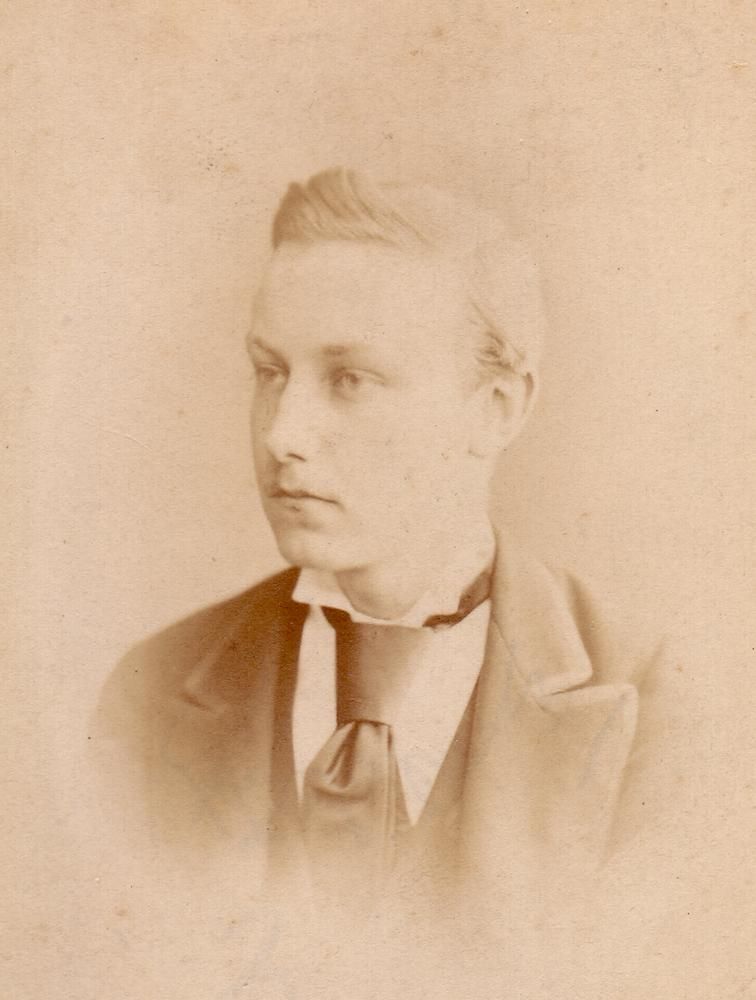 Henry Stephens Salt (September 20, 1851 - April 19, 1939), born on September 20, 1851, in Shahjahanpur, India, and passing away on April 19, 1939, in Brighton, England,
stands as one of the most intellectually pioneering and unconventional thinkers of the late Victorian and early modern eras. Best remembered as a pioneering campaigner for
animal rights, a prominent humanitarian, a literary critic, and an early advocate of ethical socialism, Salt lived a life dedicated to challenging the conventional
orthodoxies of imperial Britain. Raised in a traditional military family, he attended Eton College and subsequently King's College, Cambridge, where he excelled
academically. Following his graduation, he returned to Eton as a classic master, a position that placed him firmly within the British establishment. However, his tenure at
the elite institution proved short-lived as his burgeoning conscience rebelled against the artificiality of conventional society, the cruelties of institutional life, and
the rigid class hierarchies of the British Empire. In 1884, he resigned his post at Eton, married Catherine Joynes, and
retreated to a simpler, more radical existence in Tilbury, Surrey, where he began his lifelong journey as a writer and social reformer.
Henry Stephens Salt (September 20, 1851 - April 19, 1939), born on September 20, 1851, in Shahjahanpur, India, and passing away on April 19, 1939, in Brighton, England,
stands as one of the most intellectually pioneering and unconventional thinkers of the late Victorian and early modern eras. Best remembered as a pioneering campaigner for
animal rights, a prominent humanitarian, a literary critic, and an early advocate of ethical socialism, Salt lived a life dedicated to challenging the conventional
orthodoxies of imperial Britain. Raised in a traditional military family, he attended Eton College and subsequently King's College, Cambridge, where he excelled
academically. Following his graduation, he returned to Eton as a classic master, a position that placed him firmly within the British establishment. However, his tenure at
the elite institution proved short-lived as his burgeoning conscience rebelled against the artificiality of conventional society, the cruelties of institutional life, and
the rigid class hierarchies of the British Empire. In 1884, he resigned his post at Eton, married Catherine Joynes, and
retreated to a simpler, more radical existence in Tilbury, Surrey, where he began his lifelong journey as a writer and social reformer.
Salt’s philosophical evolution was deeply informed by the works of Henry David Thoreau, Percy Bysshe Shelley, and Richard
Jefferies, synthesizing a worldview rooted in simplicity, anti-imperialism, and profound compassion. In 1891, he founded the Humanitarian League, an organization that
operated for nearly three decades and served as an umbrella for progressive causes ranging from prison reform and the abolition of flogging to the protection of indigenous
peoples and the promotion of vegetarianism. Through the League and his prolific output of dozens of books and pamphlets, Salt articulated a holistic philosophy that viewed
all forms of oppression as interconnected. His seminal 1892 work, Animals' Rights: Considered in Relation to Social Progress, laid the intellectual groundwork for the modern
animal liberation movement, forcefully arguing that sentience, rather than rationality, should be the measure of moral consideration and that animals possessed an inherent
right to live free from human exploitation. Beyond animal welfare, Salt was a fierce critic of capitalism and militarism, aligning himself with the early socialist movement
and maintaining close intellectual friendships with prominent figures such as George Bernard Shaw,
Edward Carpenter, Mohandas Gandhi, and William Morris.
While Salt’s contributions to animal rights and social reform are widely documented, his life and ideology also intersected significantly with the emergent discussions
surrounding same-sex love, gender non-conformity, and what was then termed sexual inversion. Though Salt was heterosexually married, his social circle, ideological
framework, and personal friendships placed him at the heart of late-nineteenth-century radical queer networks. He was a central figure in the milieu surrounding Edward
Carpenter, the socialist poet, philosopher, and pioneer of homosexual emancipation who lived openly with his working-class partner in Derbyshire. Salt shared Carpenter's
vision of a liberated society where conventional Victorian morality, rigid gender roles, and institutionalized marriage would be superseded by a free, affectionate
fellowship among all people. Furthermore, Salt’s deep literary devotion to Percy Bysshe Shelley and Walt Whitman—both poets
celebrated and critiqued in their respective eras for their fluid interpretations of love and homosocial intimacy—infused his writings with an appreciation for passions that
transcended standard societal bounds.
Salt's engagement with LGBTQ history is perhaps most evident in his championing of individual liberty and his staunch opposition to state tyranny in matters of personal
morality. He was a vocal critic of the repressive legal and social penalties imposed on same-sex relationships during an era when homosexuality was heavily criminalized,
most notoriously highlighted by the trial and imprisonment of Oscar Wilde in 1895. Salt viewed the persecution of Wilde and other
sexual dissidents not merely as judicial injustices, but as symptoms of a diseased, prudish civilization that sought to crush natural human expression through dogmatic
convention. By advocating for a "simple life" that stripped away the suffocating hypocrisies of Victorian respectability, Salt helped foster intellectual spaces where
alternative domestic arrangements, non-conformist identities, and affectionate bonds outside the nuclear family model could be contemplated and validated. Henry Stephens
Salt ultimately remains a monumental figure whose visionary rejection of cruelty in all its forms anticipated modern intersectional activism, binding the liberation of
animals, laborers, and marginalized individuals into a singular, cohesive pursuit of human and ecological emancipation.
References:
- Salt, Henry S. A Plea for Vegetarianism and Other Essays. Manchester: Vegetarian Society, 1886.
- Salt, Henry S. Percy Bysshe Shelley: A Monograph. London: Reeves and Turner, 1888.
- Salt, Henry S. The Life of James Thomson (B.V.). London: Reeves and Turner, 1889.
- Salt, Henry S. Life of Henry David Thoreau. London: Richard Bentley and Son, 1890.
- Salt, Henry S. Animals' Rights: Considered in Relation to Social Progress. London: George Bell and Sons, 1892.
- Salt, Henry S. Cruelties of Civilization: A Program of Humane Reform. London: William Reeves for the Humanitarian League, 1894.
- Salt, Henry S. Percy Bysshe Shelley: Poet and Pioneer. London: William Reeves, 1896.
- Salt, Henry S. The Logic of Vegetarianism: Essays and Dialogues. London: The Ideal Publishing Union, 1899.
- Salt, Henry S. Richard Jefferies: His Life and His Ideas. London: A. C. Fifield, 1905.
- Salt, Henry S. The Flogging Craze: A Statement of the Case Against Corporal Punishment. London: George Allen & Unwin, 1916.
- Salt, Henry S. Seventy Years Among Savages. London: George Allen & Unwin, 1921.
- Salt, Henry S. Company I Have Kept. London: George Allen & Unwin, 1930.
- Salt, Henry S. The Creed of Kinship. New York: E. P. Dutton & Co., 1935.
- Winsten, Stephen. Salt and His Circle. With a preface by George Bernard Shaw. London: Hutchinson, 1951.
- Hendrick, George. Henry Salt: Humanitarian Reformer and Man of Letters. Urbana: University of Illinois Press, 1977.
- Hendrick, George, and Willene Hendrick, eds. The Savour of Salt: A Henry Salt Anthology. Centaur Press, 1989.
Support this project
This website is a passion project researched, developed, and funded entirely by me. If you find the content valuable and would like to help support the ongoing research and hosting costs, any contribution is deeply appreciated.
Thank you for keeping this independent resource alive!
My books on Amazon: Elisa Rolle's books
BACK TO HOME PAGE